
The Petrovic 3-6-1 Formation
Over the half-century that I have been watching the game of football, the basic formation, styles of play and patterns of team organization have changed dramatically. For those wondering just how much of a boomer I am, the first formation I ever played was the 2-3-5. Football has come a long way since then. Even in just the past few decades, there has been a global shift from the use of two attacking players up front, usually in a 4-4-2 formation, to the recently "mainstream" pattern of using a single front man, in one of several formations designed to create more width. Often the evolution of formations and playing styles is gradual, as in the case of the transition from the 4-4-2 of the 1990s and early 00s to the 4-1-4-1, and then ultimately to the 4-2-3-1. In this case, the transition developed as one of the two strikers began to adopt more and more of a supporting, playmaking role until eventually people began to list this player as an attacking midfielder.
There have been similar gradual transitions in the more distant past, such as the conversion of the old "centre half" (a midfield player) into someone who sits at the core of the defence. Even today it is commonplace - especially in England - to describe the tall players who anchor the back row as a "centre half," even though this appellation is now a misnomer.
Every now and then a coach or group of coaches in a league somewhere in the world will introduce a dramatically different philosophy and formation. Sometimes these experiments are discarded after just a brief period, because opponents find ways to exploit them and the value of novelty is not enough to offset fundamental weaknesses. Other times, these experiments can completely alter the conventional thinking in football circles. The new system is so effective at attacking the weaknesses in an existing football style that everyone in the league has to revise their thinking, and adopt new strategies.
Japanese fans will be familiar with several examples of such changes in football strategy. Phillippe Troussier famously introduced the "Flat Three" system and used it to help Japan make its first trip into the knockout round, in 2002. The flat three relied on a lot of gimmickry and surprise, however, and after his stint with the Samurai Blue, Troussier was never again able to achieve the success needed to give his philosophy any global impact.
Another national team coach, Alberto Zaccheroni, had a slightly greater impact with a three-back formation, at least on coaches in Serie A and a few other leagues. Zaccheroni states that his first experiment with the system, at Udinese, was accidental. One of his defenders was sent off, and since the team were trailing by a goal, he decided not to bring on another defender. Instead he had the three remaining defenders play closer together in the back, and asked his midfield wings to work harder playing the sidelines at both ends. The system proved to be so effective that the following week he decided to stick with three men at the back.
When Zaccheroni moved from Udinese to AC Milan, he was provided with one of the premier "one-top" strikers of recent memory - Oliver Bierhof. The combination of Zac's 3-4-3 philosophy with players who could take advantage of the system's strengths brought Milan the Scudetto that season. Although most other teams in Italy continued to play with four men at the back, the new concepts that Milan brought into the game were a key factor in bringing about - or at least accelerating - the shift to a lone striker.
I do not mean to ramble on about past history and ideas that have already been dissected by dozens of writers in the past. I provided the above introduction for two reasons. First, it is important to understand the importance of new ideas, and their potential to completely change the way that the game is played, worldwide. The second reason, though, is that Zaccheroni's 3-4-3 system arrived in Japan at the same time that a new strategy was beginning to take hold in the J.League -- a system that was long referred to as the "Petrovic 3-6-1" but may now be remembered internationally as the Moriyasu 3-6-1. In the decade since I wrote the original version of this article (in early 2014), the system has been refined and adapted by dozens of J.League coaches. The sheer ubiquity of the 3-6-1 in Japan's second and third divisions should indicate just how effective it can be, with the right players.
Although the 3-6-1 system is founded on past experiments with a three-man back line, it has some unique features that can only be countered if the opposing team makes strategic adjustments of its own. A system that forces opponents to abandon their own game plan has great potential to revolutionize the game.
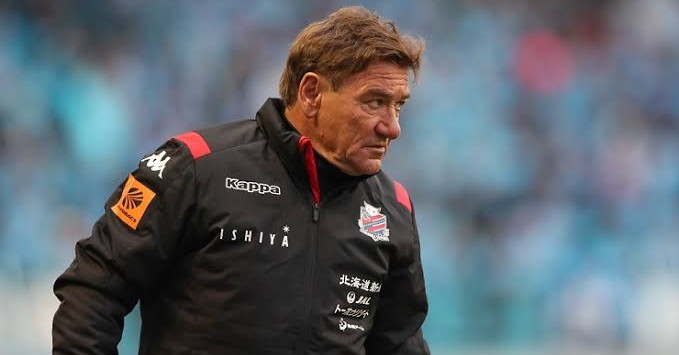
The system was first introduced by Mihailo Petrovic, at Sanfrecce Hiroshima. After a few years and some decent success with a club that (at the time) was viewed as decidedly mid-tier, Petrovic moved to the more financially-fluid Urawa Reds, and used his formation to win an Asian Champions League title. The man who succeeded Petrovic at Sanfrecce, however, is the man who took the 3-6-1 to its next level. Though Petrovic took some of his best players with him to Urawa, within a few years Hajime Moriyasu had built Sanfrecce into a J.League champion, and then repeat champion. He won three titles with the Purple Archers before moving on to the National Team coaching ranks.
I will discuss some of the reasons for his success in more detail below, but the adjustments introduced by Moriyasu (and a number of other J.League coaches who have refined the system in recent years) took a largely defensive-minded system and gave it tactics that generate instant offense. Petrovic has remained in the J.League ever since, coaching at teams like Consadole Sapporo and Nagoya Grampus. His impact on the Japanese game is hard to overstate. Every coach in the league has been forced to learn his formation and his tactics, even if only to defend against them.
In this article, I intend to examine the characteristics of the 3-6-1 system, its strengths and weaknesses, and the potential this system has to turn Japan into one of the leading football countries in the world. When I wrote the first version of this article in 2014, I concluded this introductory section by saying:
"I still have hope that the Japan National Team may adopt the system, or at least some blend of the Zaccheroni 3-4-3 and the Petrovic 3-6-1, before next year's World Cup. But even if Zac sticks with the 4-2-3-1 in 2014, Petrovic is surely one of the top candidates to take over as Japan's next NT coach. Whether it happens sooner or later, I think the Samurai Blue may very well be able to ride this 3-6-1 system to World Cup glory."
The Formation - Overview
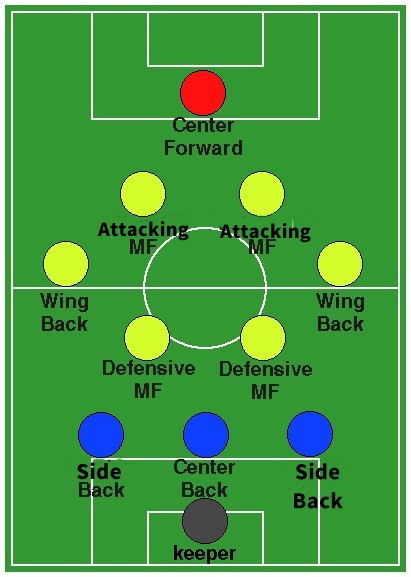
The general layout of the 3-6-1 formation is shown in the graphic above. Some have likened the shape to a Christmas tree; others, particularly supporters of Sanfrecce, describe it as an "Arrowhead." The most immediate impression one receives when viewing it for the first time is that it seems to be a rather "narrow" alignment, with open spaces in all four corners of the pitch. This impression is not entirely inaccurate. When first introduced by Petrovic, one of the weaknesses of the formation was that it can "collapse" if the opposing team gets the ball behind the defence and into the attacking corner. This space in the back line is still one of the few structural weaknesses. One essential prerequisite, for teams that adopt the formation, is that the keeper must be quick off the line, and skillful enough with his feet to evade pressing players, and pass the ball effectively from his box.
The underlying design concept for the 3-6-1 system is to create choke points in midfield and win the ball back by compressing the area of play until there are no open passing lanes. In other words, the "narrow" alignment is intentional. Japan not only uses this "narrowness" to surround the ball on defence, but also to give them wide areas to attack into, if they do win possession.
The reason why most Japanese analysts refer to the formation as "3-6-1" rather than a "3-4-2-1" (as it is drawn up in the graphic) is that the six midfielders are using tactics that genuinely deserve to be called "total football". You can not say definitively that - for example - Takefusa Kubo plays in the right slot (attacking midfilder) and Ritsu Doan is a right wingback. If you watch the run of play, not only will Doan and Kubo swap roles frequently, but they also may swap sides with the other two offensive midfielders, or just overload on the opposite wing. Alternatively, Doan may tuck in towards the centre as Kaishu Sano or Daichi Kamada step forward into the attacking midfield. In short, the six players are a single unit that has shared responsibilities. Who fills each role in that six-man midfield can change from minute to minute.
Like a 3-4-3, the 3-6-1 formation creates a lot of triangles in midfield, which allow the team to move the ball quickly forward using short passes. On defence, these triangles serve to limit the number of passing lanes, and also allow players to double-team quickly, without having to stray too far from their positional responsibilities. Over the years, coaches such as Moriyasu have made slight refinements to the basic layout. The most notable of these is the evolving role of the back three, and how they function in both attack and defence.
In Petrovic's initial system, the centre back functioned as a true "libero" in the mold of Franz Beckenbauer or Lothar Matthaus. Although he has some degree of positional responsibility when defending, when the team is in possession he has complete freedom to roam. Tomoaki Makino played for Petrovic at both Sanfrecce and Reds, and his ability to suddenly surge forward to snap a high back line became legendary. In a formation that already creates a lot of overloads, there are many opportunities for a deep-lying player to suddenly surge forward and find an open lane through the defence. The drawback to the original Petrovic system was that this often left the formation with even MORE open space at the back (see PICTURE 3, below). If the DMFs failed to respond and retreat quickly enough, the opposing counterattack had acres of space to run into.
Moriyasu [and too many other coaches to all be named here] made a few particularly "Japanese" tweaks to the philosophy. First, after analysing the relative positions of all the players, they began to consciously use the side backs as the potential "overload creators" rather than the centre back. The defensive responsibilities of the side backs can be covered by EITHER the DMF, or by the wing back on the same side. This limits the amount of open space that could be exploited if the opposition wins the ball.
Second, and perhaps more importantly, a multitude of coaches in the J.League began experimenting on their own, plotting out the movements of the side backs, and the other overloads, then having their players practice them rigorously on the training pitch. In the original Petrovic 3-6-1, Makino would signal when he was about to move forward, but his movement was largely instinctive and came whenever he happened to spot a gap in the defence. Moriyasu and others began to diagram out the overloads and double-teams, in rigorous detail, and have the players execute them over and over in training.
In the current top-line version of the 3-6-1, whenever a deep-lying player surges forward into the attack, all the other players know that their responsibilities have changed, and they adjust accordingly. Everyone knows who is expected to shift into which backup role. By the time you reach the National Team level, the overloads are created very deliberately, with the entire team knowing their responsibilities at all times. This helps to explain the resilience of Japan 's defence against the counterattack. When they concede, they usually concede to a well-executed play that exploits some defensive mismatch.
The biggest "positional" difference between this formation and a standard 3-4-3 like the one used by Zaccheroni is that the two attacking midfielders slot in just behind the striker, rather than out on the wings. Zaccheroni's use of the 3-4-3 allowed his teams to outnumber the opponent on the flanks, creating lots of dangerous crosses from the wing. That width is useful when you have a big man like Bierhof to exploit the crosses.
The 3-6-1 has just the opposite intent. Though the positioning of the wide midfielders allows them to dash quickly into the corner for a cross, more often than not they will cut back to the inside. When they do (assuming they've gotten past their marker), the attacking midfielders are lined up directly in the left and right channels, creating a numerical advantage in the seams of a four-back line. Historically, teams playing a 3-6-1 (especially Sanfrecce and Reds) score a large percentage of their goals from these two channels.
Defensive Characteristics
The strategic underpinning of the 3-6-1 formation is the idea that the most effective offensive plays are those that start out from a position high up the pitch. Rather than trying to create chances through steady build-up, it tries to generate most of its offense on the counterattack. Defence, therefore, is active and aggressive, rather than reactive and risk-averse. The objective is to crowd the midfield, compress the active area of the pitch, surround the ball and win possession high up the pitch.
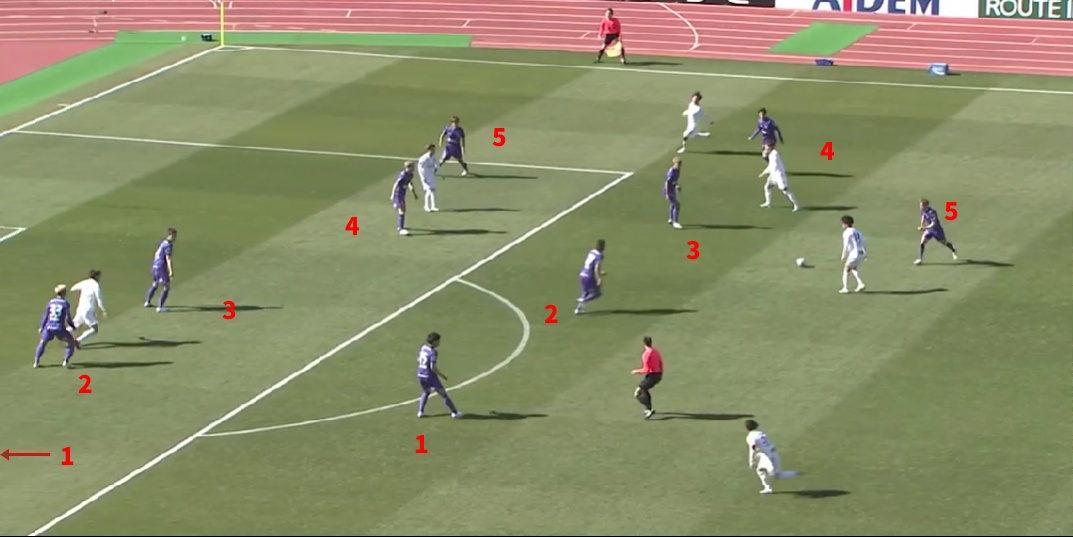
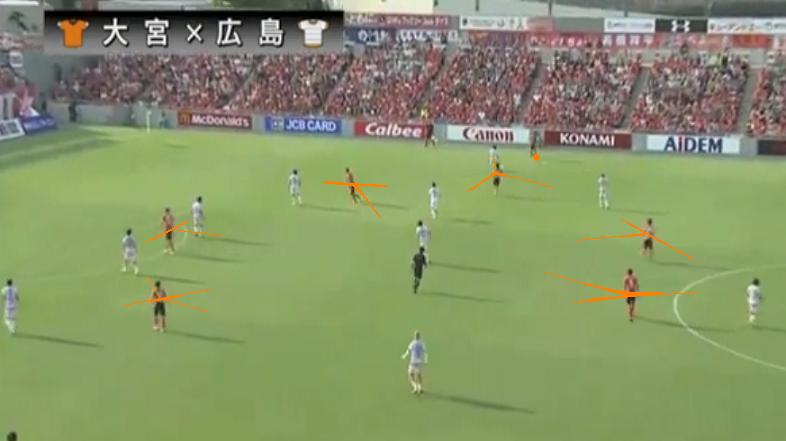
PICTURE 1
As PICTURE 1 shows, when the team compresses into its defensive block, it creates not two lines of four, as is typical of a conventional defence, but two lines of FIVE. Looking at it in this form, it diagrams as a 5-4-1. The opposing team is still outnumbered in midfield, and there are five players on the attacking side of the formation, who can all break out on the counterattack in a separate "lane." Notice that the entire block is extremely narrow. Only one defender is out of the frame, on the right half of the pitch.
A second feature of the defensive tactics of the 3-6-1 is the fact that opposing players usually are not marked by a single man. Rather, the formation seeks to "bracket" every opposing player so that when the ball comes to them, two or three defenders can converge and surround the ball (or alternatively, cut off the passing lane). PICTURE 2 shows how the defenders align themselves in positions to "bracket" all players in the attacking zone (in orange). When the pass is made, the nearest defenders converge and - as you can see in PICTURE 1 - seek to trap the ball while also blocking any passing lanes.
PICTURE 2
While any good defensive structure will try to achieve this same goal, the difference is that the 3-6-1 resolves into lines of five, as noted above. Most modern offensive formations resolve into four vertical lanes, which the attackers will target (or six, if you include the touchline "lanes"). The 3-6-1 resolves into five (seven including the touchline itself). As we have already noted, the formation is structured to be narrow, so the "active lanes" are even narrower.
Assuming that the players stick to their positional responsibilities, the run of play should naturally flow in ways that allow you to trap the ball between two defenders. Furthermore, the width of each active lane is so narrow that you can almost always use the touchline as an "extra defender." The BIGGEST reason that Japan win the ball back so effectively with their trap is that they work really hard, and have practiced the trap timing for months. But the formation itself - together with the bracketing tactics (ie. player positioning) - make the job much easier.
The 3-6-1 does have its weaknesses, and naturally J.League teams have spent a lot of time trying to develop plans that exploit these weaknesses. The most consistent problem that both Sanfrecce and Reds have faced is directly related to its underlying philosophy of counter-attacking football. A counter-attacking strategy naturally does not work if the opponent never attacks. Over the years, Sanfrecce often finished the season at mid-table despite having a winning record against all of the top teams. The problem was that they couldn’t defeat the bottom-ranked teams, who played the proverbial "ten men behind the ball" strategy.
The other weakness is that the 3-6-1 only works well if the team using it compresses the pitch. Since it deliberately leaves space in wide areas of the pitch, it will always be vulnerable to opposing counter-attacks. Of course, Japan's players know where those vulnerabilities are and will react instantly to try to cover the danger. If you do not switch play to get the ball into space immediately upon winning it, Japan will scramble back into the 5-4-1 and the opportunity will be gone.
But that doesnt negate the danger. Since the basic strategy is founded on the idea of compressing the area of play and "trapping" the ball (and the formation is narrow to begin with), there will always be space in the corners for opponents to run into, if they can just get the ball into these areas quickly enough. PICTURE 3 shows a developing counter-attack by Reds in a match against Hiroshima. As you can see, even though the Sanfrecce players are doing their best to react, and cut off the passing lanes, there are huge areas of space in the corners for Reds players to run into.
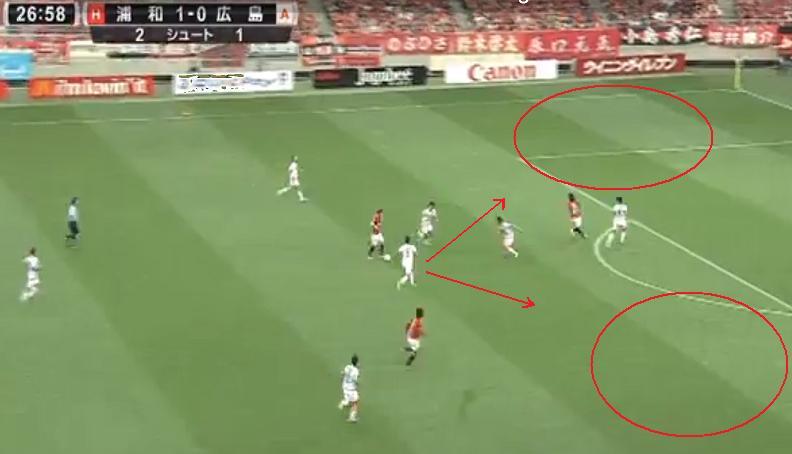
PICTURE 3
Offensive Characteristics
The advantages of the 3-6-1 when on the attack are similar to those that apply on defence. After all, the basic strategic concept is for the defence to win the ball in advanced positions, and counter-attack quickly. Since counter-attacks can break out from just about anywhere on the pitch, the 3-6-1 relies on the ability of all ten field players to join the attack when necessary. It should be noted that teams playing the 3-6-1 historically tend to have less possession than the opponent. This is a feature of the formation, not a deficiency. When you have the ball, your objective is to get it into attacking areas as quickly as possible. If you happen to rush your build-up, and lose possession. that is perfectly fine . . . so long as it doesn't lead to a counter-attack. The assumption is that - since counter-attacks are your forte - you are more dangerous when NOT in possession.
As I noted earlier, one feature of the 3-6-1 is the ability to create numerical mismatches in the "channels." Against a back four, the three players at the point of the attack outnumber the central defence. Either a midfielder or a side back needs to drop in to support the back line. Therefore, when a wide player cuts inside, there will not only be an "irregular line" guarding these attackers, but there will also be no spare defender to charge the ball. You must either leave your man unmarked and challenge the dribbler, or back off and allow the dribbler to move across the top of the penalty arc and search for open teammates.
When play does build from the back, the build-up tends to employ a lot of vertical passes, which also create problems for the defence due to the narrowness of the formation. For example, as a vertical pass comes in to one of the three central attackers from midfield, there will be a numerical advantage in one of the two channels. Therefore the player receiving the pass can redirect it (or simply dummy) and let the ball bound into the box for his cutting teammate. Junya Ito's goal against Tunisia [PICTURE 4] is a perfect illustration. If the second central defender breaks off and follows the cutting player, the pass recipient can quickly turn and get off a shot. There are numerous variations on this, as tactical coaches develop their own new wrinkles. But the underlying principle is the same - you should always have more players close to the ball than the other team.
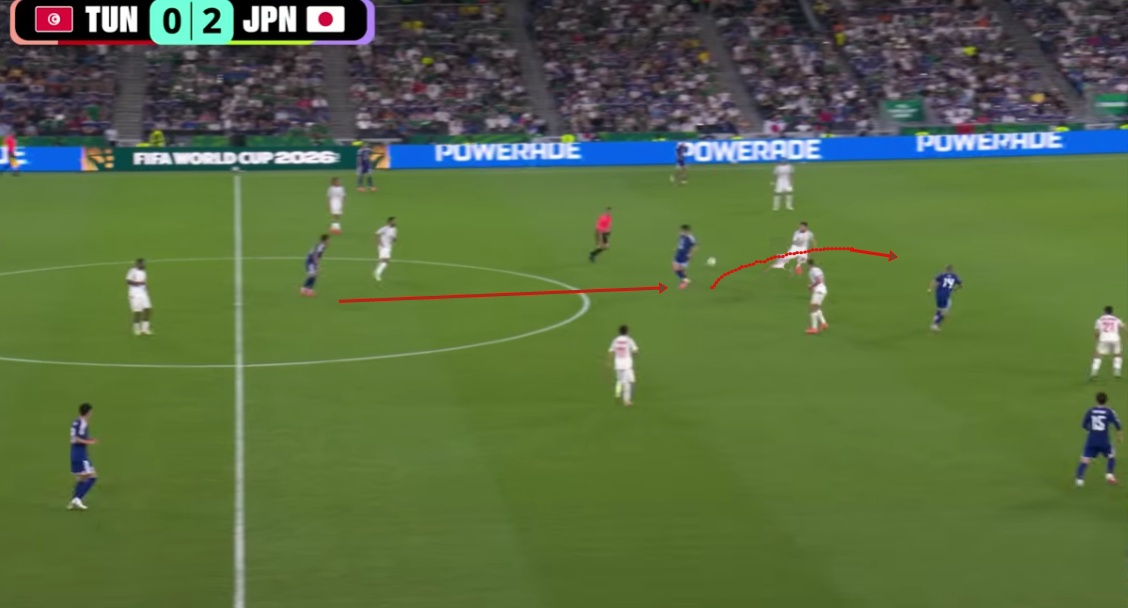
PICTURE 4
In the 3-6-1 formation, the two midfield wings have a difficult role to play. On defence, they function effectively like wing backs in a four-back line. That is to say, they not only have the defensive responsibility of covering the touchline all the way to the corner flag, but they also are expected to rush forward and press the opposing side back/wing back. Once the ball is won, the wing back is expected to provide much of the "thrust" on attack. They may either combine with the shadow striker to work the ball into the corner for a cross, or they can cut inside to either create a numerical mismatch in the channel, or to loop a long pass to the opposite wing.
Players who fill this wing back role must have great stamina and speed, as well as competent two-way skills. When the formation was first introduced by Petrovic, one of the big criticisms fans had was that the burden on these players was too great. Even if the wing backs were subbed out at the 60 minute mark, they would often cover more than 10 km in a match. As a result, the wide game would deteriorate as the contest progressed, and Sanfrecce often succumbed to late goals by their fresher opponents.
The first adjustment that coaches made to address this problem was to increase role-switching. As noted in the introduction, the wing backs in the Samurai Blue 3-6-1 often swap roles with the attacking midfielders. This shares the burden and prevents any one player from getting too fatigued. Other teams have used different rotation patterns, but essentially the solution is based on the idea that the midfielders should be interchangeable - something that is already a feature of the 3-6-1.
An even bigger boost came with the advent of the five-substitute rule. Now it became possible to replace all four of the "hard-running" members of the team, and still have a spare sub in case of injuries. Many commentators have talked about how unusually "deep" the Japan National Team is. That should be no surprise when you consider that the 3-6-1 almost DEMANDS that you have 16 first-team-quality players available for every contest. Teams have to be deep, because the subs play such an essential role.
Just as is the case on defence, the underlying tactical concept of Japan's offense is to always have more players in the active area of play than the opponent. This usually involves a player from either the opposite side of the pitch, or from the back line, moving from their usual area of defensive responsibility and joining the attack. When Petrovic first introduced the system, his favoured approach was to use centre back Tomoaki Makino as a pure libero. Makino had excellent ball skills and good finishing instincts, so when he suddenly dashed forward into attack and created numerical mismatches, it frequently disrupted the defence enough to produce a goal. Petrovic brought Makino with him, from Sanfrecce to Urawa Reds, specifically to fill this role.
However, time would show that this often would also result in catastrophic counter-attacks. When the centre back advances, one of the DMFs must cover his theoretical "lane" in defence. if the opposing team intercepts. In practice, it was often difficult for them to get back into this position quickly enough, because to do so, the DMF often had to drop their coverage of opposing midfielders. Furthermore, if the libero was caught in an exposed position, the most technical and ball-savvy member of the defence was now missing from that defence, and unable to intervene to break up a counter-attack.
In time, most teams using the 3-6-1 abandoned this "libero" concept and began using one or both of the side backs for the purpose of adding a body to the attack. When one of the side backs advances, both the DMF and the midfield wing are in position to cover for their advance. None of the defensive "lanes" is left open, and if there is a counter-attack you have two players (actually three including the centre back) available to push the opponent wide and slow the counter.
Over time, coaches have adopted a number of other tactical tricks to achieve the same result. The key is for everyone on the team to know their role, and to move quickly so that you always outnumber the opponent in critical areas of the pitch. Positional awareness is essential, but nothing is more important than teamwork. The ball traps all need to be timed precisely, so that two players arrive in time to at least fill all passing lanes, if not to actually win possession. The offensive switches have to be ingrained on every player such that they instinctively move to fill gaps. Because a missed assignment gives the opponent a path into those "wide open spaces" that the formation creates on opposite sideline. It is not a system that can be introduced and successfully executed overnight (as Glasgow Celtic fans discovered in the middle of last season). The 3-6-1 requires a talented, intelligent, well-drilled and extremely "unselfish" team, to derive the maximum benefit.
In short, it is the perfect formation for the Samurai Blue.
Conclusions
The most important characteristics of the 3-6-1 are all factors that suit the skill set and inclinations of Japanese players. Perhaps most importantly, the defensive focus on compressing the area of play and denying passing lanes tends to reduce the importance of size and aerial prowess. If you deny the passing lanes that let the opponent pick out a big target man, then that target man is no longer dangerous. Most of the back-line players that Petrovic and Moriyasu have used over the years are finesse players rather than "athletes." Indeed, the tallest players on his teams are often the two deep-central midfielders.
The same is true on offense. Since most of the offensive thrusts come through the channels, there is no need for a tall, powerful center forward. You do need someone with the strength and body-positioning skills to win the ball up front and lay it off to cutting teammates. However, sheer height is irrelevant. When crosses do come in, they often are short diagonal balls from the channels, or "back-passes" from the goal line. Even smaller players can get on the end of this type of cross for an angled header, as 169cm Hisato Sato demonstrated throughout his career as the "target man" for Sanfrecce. If you're tempted to chuckle, the diminutive Sato scored 220 goals in his J.League career, and four for the National Team.
The defensive, counter-attacking nature of the 3-6-1 also makes it a good option for Japan when playing world-class opponents in tournaments such as the Confederations Cup or the World Cup. The weaknesses of the system generally emerge when Japan is playing qualification matches against Asian opponents who put ten men behind the ball and ONLY break their defensive block for a counter-attack. These are difficulties that Urawa and Hiroshima often experienced when playing bottom-half teams in the J1. But as the years go by and new coaches develop new strategies for attack, this shortcoming will surely be addressed. The formation will always be a slightly risky one. It is the sort of high-risk/high-reward philosophy that is often needed to shake up the football orthodoxy.
In any case, I suspect that football fans around the world will be seeing much more of the 3-6-1 in the future.